

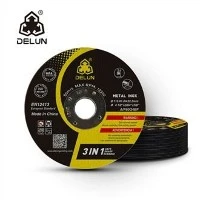


Hey there! As a grinding disc supplier, I often get asked how resin-bonded grinding discs work. Well, let's dive right in and break it down in a way that's easy to understand.
First off, let's talk about what a resin-bonded grinding disc is. It's a type of grinding tool that consists of abrasive grains held together by a resin bond. The abrasive grains are the actual cutting elements, and the resin bond acts like a glue, keeping these grains in place while they do their job.
The abrasive grains in a resin - bonded grinding disc can be made from different materials, each with its own unique properties. For example, green silicon carbide is a popular choice. It's super hard and has excellent heat - resistant properties. If you're in the market for a green silicon carbide grinding wheel for stone, you can check out Green Silicon Carbide Grinding Wheel For Stone.


When the grinding disc is in operation, the first thing that happens is contact with the workpiece. As the disc spins at high speed and touches the surface of the material you're grinding, the abrasive grains start to dig into it. This contact creates friction, and it's this friction that generates the heat needed to remove material from the workpiece.
The resin bond plays a crucial role here. It has to be strong enough to hold the abrasive grains firmly in place during the grinding process. If the bond is too weak, the grains will fall out too easily, and the disc won't last long. On the other hand, if the bond is too strong, the worn-out grains won't be able to come off, and the disc will become dull. So, finding the right balance is key.
As the abrasive grains start to wear down from grinding, they need to be replaced. The resin bond is designed to break down gradually, allowing the worn - out grains to fall off and exposing fresh, sharp grains beneath. This self - sharpening mechanism is what keeps the grinding disc cutting effectively over time.
Another aspect of how a resin - bonded grinding disc works is related to the type of grinding operation. There are different types of grinding, such as surface grinding, cylindrical grinding, and angle grinding.
In angle grinding, which is a very common application, the disc is used to shape, cut, or clean a variety of materials. For more info on angle grinding disc specification, you can visit Angle Grinding Disc Specification. When you're using an angle grinder with a resin-bonded disc, the disc spins at high RPMs (revolutions per minute). The high speed combined with the sharp abrasive grains allows for quick material removal.
Let's take a look at the materials that can be ground with a resin - bonded grinding disc. It can be used on metals like steel, stainless steel, and aluminum. Each metal has different hardness levels, and the grinding process needs to be adjusted accordingly. For softer metals like aluminum, you might want a less aggressive abrasive or a disc with a different type of resin bond.
In the case of non-metallic materials, such as stone, ceramics, and concrete, resin-bonded grinding discs are also very useful. For example, if you're working on a concrete project and need to polish it, a Wet Concrete Water Polishing Pad can be a great option.
The flexibility of a grinding disc is also an important factor. Some discs are more flexible than others, and this can be beneficial in certain applications. For instance, a Single Net Flexible Green Grinding Wheel can conform to the shape of the workpiece better, making it easier to grind irregular surfaces.
Now, let's talk about some of the factors that can affect the performance of a resin-bonded grinding disc. The speed at which the disc rotates is crucial. If the speed is too low, the disc won't cut effectively, and if it's too high, it can cause the disc to wear out quickly or even break.
The pressure applied during grinding also matters. If you press too hard on the disc, it can generate excessive heat, which can damage both the disc and the workpiece. On the other hand, if the pressure is too light, the grinding process will be slow and inefficient.
The quality of the resin bond and the abrasive grains also has a big impact on performance. High-quality materials will result in a longer- lasting and more effective grinding disc. That's why at our company, we always make sure to use the best materials available to produce our grinding discs.
For those of you who need a compact and flexible grinding solution, the DELUN 4 Inch Flexible Grinding Disc is a great choice. It offers a lot of flexibility in terms of the types of work you can do with it.
In conclusion, resin-bonded grinding discs are incredibly versatile tools. They work by using abrasive grains held together by a resin bond to remove material from a workpiece through friction. The self-sharpening feature of the disc ensures that it can keep cutting effectively over a long period of time.
If you're in the market for high-quality grinding discs, we've got you covered. Whether you need a disc for metalworking, stone grinding, or concrete polishing, we have a wide range of products to meet your needs. Feel free to get in touch with us to discuss your requirements and start a purchase negotiation. We're always ready to help you find the perfect grinding disc for your project.
References
- Grinding Technology Handbook
- Abrasive Materials and Their Applications Literature