




If you've ever stood in a workshop, staring at a pile of concrete that's covered in old paint, rust, or stubborn mortar, you've probably wondered: can a cup brush for grinder be used on concrete? As a supplier of cup brushes for grinders, I get this question all the time-from weekend warriors tiling their back patios to professional contractors prepping concrete surfaces for epoxy, and even metal fabricators who accidentally grab a concrete brush instead of a wire cup. The short answer is yes, but it's not as simple as grabbing any old cup brush and going to town. There are right tools for the job, critical limitations that can damage your concrete or your grinder, and best practices that make the difference between a smooth, finished surface and a ruined project. Let's break this down with real-world experience, not just textbook theory.
First, let's get clear on what a cup brush for grinder actually is. At its core, it's a circular brush with stiff bristles (usually metal wire, for heavy-duty work) mounted to a arbor that fits onto a standard angle grinder. The design lets you apply even, downward pressure to abrade surfaces, making it ideal for stripping, cleaning, or smoothing rough materials. Now, concrete is a tricky substrate: it's a hard, porous, somewhat brittle material, with a surface that can be uneven, have embedded aggregate, or have coatings that range from soft latex paint to tough epoxy. The wrong cup brush will either chew through the concrete too aggressively, leave deep gouges, or wear out in minutes. The right one will take off just the material you need, without causing permanent damage.
I've seen so many people make the mistake of grabbing a random wire cup brush meant for metal work to tackle concrete. I remember a customer last spring who tried to use a cheap crimped wire cup brush (the kind you'd use to clean rust off steel beams) on a concrete patio that had 10-year-old oil stains and peeling paint. By the time he was halfway through, the concrete was pitted in spots, and the wire bristles were bent so bad they barely worked. That's because crimped wire-soft, flexible, and designed to conform to irregular metal surfaces-isn't stiff enough to grind dense concrete. When you apply pressure, the crimped wire bends instead of cutting into the concrete matrix. Sure, it might strip paint, but it will also round over the concrete's sharp edges and leave a fuzzy, uneven finish that requires hours of extra sanding to fix. If you're set on using a wire brush for concrete prep, you need to look for bristles that are dense, stiff, and made for aggressive material removal. That's where specialty cup brushes for concrete come into play.
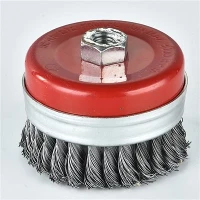
Wait, but let's not write off wire cup brushes entirely-they can actually work for lighter concrete tasks, as long as you match the brush to the job. For example, if you're dealing with a thin layer of paint or a light dusting of grout haze on a concrete countertop, a finer wire cup brush might be perfect. If you have a project that requires precision, like blending small spots on a concrete repair, a smaller 75mm twisted cup wire brush is easy to maneuver, so you don't accidentally dig into the surrounding good concrete. I can point you to a solid option here: the DELUN 75mm Twisted Cup Wire Brush is designed with high-tensile wire that's twisted for extra stiffness, so it cuts through light concrete coatings without overworking the surface. It's small enough for tight corners, too, which is a win for detailed work.
For heavier concrete jobs, like removing thick epoxy or mortar from a floor, you need something more heavy-duty. Let's talk about knotted wire cup brushes. Knotting the wire strands makes them much stiffer than crimped or twisted wire, so they can apply more downward pressure without bending. A super quality steel knotted wire cup brush is built for high-impact tasks-they'll strip thick layers of old paint, grind down high spots in concrete, and even remove small rust spots from rebar that's embedded in concrete (something regular metal brushes can't handle). I've used these on commercial construction sites where we had to prep concrete for new flooring, and they cut our prep time by almost half compared to traditional concrete grinders. That said, knotted brushes are aggressive-you have to go slow and apply even pressure, or you'll gouge the concrete. It's not a brush for beginners, but it's a lifesaver for large-scale concrete work.
Now, let's address the big caveat: even the best cup brush for concrete has its limits. You should never use a cup brush for grinder that's rated only for low RPMs on high-powered grinders. Most angle grinders run between 8,000 and 12,000 RPM, and if you put a cup brush that's designed for metal working on there, you run two big risks: the brush could fly apart (which is a major safety hazard) or it will wear out in seconds. That's why you always check the speed rating of your cup brush-concrete-specific cup brushes are rated for high RPMs, so they can handle the speed of standard grinders. Another limit: cup brushes don't work well on very delicate concrete surfaces, like polished concrete floors that have a low-gloss finish. The abrasive action of the wire will scratch the polished layer, so in that case, you'd want to use a fine diamond pad instead of a wire cup brush. I always tell customers to match the tool to the surface hardness: concrete is rated on the Mohs scale, and if it's above 5, a metal wire cup brush might be too aggressive. For reference, glass is a 5, concrete usually ranges from 3 to 7, so you have to test a small hidden spot first before committing to a large area.
Wait, some people ask: can I use a generic metal wire brush, not specifically made for concrete, on concrete at all? Yes, but only for very light tasks. For example, if you're removing a tiny bit of mortar smudge from a concrete block, a metal wire brush for polishing 3inch is fine. The smaller diameter means it's less aggressive, so you don't dig into the block. I've used this exact brush for small cleanup jobs on masonry, and it works perfectly-just don't expect it to take off a thick layer of paint. But for anything more than light cleanup, generic metal brushes are not ideal. They don't have the stiffness or durability of concrete-specific brushes, so they'll break or bend quickly, costing you more money in the long run.
Let's get into a few real best practices I've picked up over the years as a cup brush supplier. First, always wear the right safety gear when working with cup brushes on concrete. The abrasive action kicks up a lot of silica dust, which is bad for your lungs, so a N95 or N100 respirator is non-negotiable. Eye protection is a must too-wire bristles can fly off, and concrete chips are sharp. Ear protection is also good, since grinders are loud. Second, use the right grinder for the job. A 4-inch angle grinder works for small, detailed work, while a 7-inch grinder is better for large concrete floors. The larger the grinder, the more power it has, which pairs well with heavier-duty cup brushes. Third, keep the brush moving. Don't hold it in one spot for more than a second-this will dig into the concrete and leave a deep indent. Make long, overlapping passes, like you would when painting, to get an even finish. Fourth, replace your brushes when they're worn out. A brush with bent or broken bristles won't work properly, and it will create uneven results. If you see bristles fraying or sticking out at weird angles, it's time to swap it out.
I also get asked a lot about the difference between cup brushes and other concrete tools, like angle grinders with diamond pads. Diamond pads are great for polishing concrete to a high shine, but they're not as good for stripping coatings. Cup brushes are better for aggressive material removal, so if you have a floor with multiple layers of paint, a cup brush will get through that much faster than a diamond pad. The DELUN 5 Inch Twisted Wheel Brush For Polishing In High Performance is a middle ground-stiffer than standard twisted brushes, but not as aggressive as knotted ones, so it's perfect for when you need to smooth out concrete after grinding, not strip heavy coatings. It leaves a uniform texture that's great for preparing concrete for epoxy or tile, since it gives the mortar something to grip onto.
One common mistake I see is people applying too much pressure when using a cup brush. A lot of folks think more pressure equals faster work, but with cup brushes, the opposite is true. The grinder's speed and the bristles' stiffness do most of the work-if you press too hard, you'll bend the bristles, wear them out faster, and increase the risk of gouging the concrete. I always tell customers to let the tool do the work, just guide it slowly across the surface. For delicate concrete, even lighter pressure is better. I had a customer last year who was refinishing a concrete countertop and tried using a heavy-duty knotted brush with too much pressure-he ended up with a gouge that took him three hours to repair with a concrete patching compound. That experience led him to switch to a finer crimped wire cup brush for the final prep steps, and he got the smooth, even finish he wanted.
Let's also talk about maintenance for your cup brushes, because taking care of them will make them last longer and work better. After every use, use a wire brush cleaner tool to remove any concrete dust or debris stuck in the bristles. If you leave concrete dust in the brush, it will harden over time, making the bristles less effective. Also, store your brushes in a cool, dry place-moisture can cause the wire to rust, which weakens the bristles and makes them more likely to break during use. I always recommend not overbuying brushes, since they have a shelf life, but keeping a few of the most common sizes (75mm for small jobs, 5-inch for large jobs) in your workshop will save you time when you need them.
Now, let's wrap this up with a clear answer to the original question: yes, a cup brush for grinder can be used on concrete, but only if you choose the right type of brush for your specific task and follow proper safety and usage guidelines. Generic metal wire brushes work for light cleanup and small jobs, but for heavy stripping, smoothing, or large-scale concrete prep, you need brushes designed for that application. From my experience as a cup brush supplier, the DELUN line of twisted and knotted cup brushes are some of the most reliable options for concrete work, built to handle the harsh demands of grinding concrete without failing.
If you're working on a concrete project and aren't sure which cup brush is right for you, or you need high-quality, durable brushes to get the job done efficiently, we're here to help. Choosing the wrong brush leads to wasted time, extra costs, and even safety risks-let us connect you with the perfect solution for your concrete prep needs. Reach out to our team of experts to discuss your project requirements, and we'll help you find the right cup brush to get your concrete job done right, on time, and on budget.


References
- Abrasive Safety Standards for Angle Grinders and Wire Brushes, Occupational Safety and Health Administration (OSHA), 2022
- Concrete Surface Preparation: Best Practices for Coating Adhesion, American Concrete Institute (ACI), 2021
- Wire Brush Performance Testing for Industrial Applications, Industrial Abrasive Manufacturers Association (IAMA), 2023
- Safety Guidelines for Using Wire Brushes with Power Tools, National Institute for Occupational Safety and Health (NIOSH), 2022
- Masonry and Concrete Finishing Techniques, Construction Skills Coalition, 2021