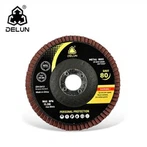
Grinding discs are fundamental abrasive tools used in industrial processing for surface grinding, material shaping, deburring, and edge blending. Unlike cutting discs, which are designed for material separation, grinding discs focus on removing small amounts of material to achieve precise surface roughness, dimensional accuracy, and geometric shape. Widely utilized in metalworking, automotive, aerospace, and manufacturing industries, grinding discs are available in a diverse range of types and specifications to meet the unique requirements of different applications.
The structure of a grinding disc consists of three main components: abrasive grains, a bonding agent, and pores. Abrasive grains are the cutting elements, and their type, size, and hardness directly impact the grinding performance. Common abrasive materials include aluminum oxide (for grinding carbon steel, alloy steel, and cast iron), zirconia alumina (for high-efficiency grinding of stainless steel and heat-resistant alloys), and cubic boron nitride (CBN) and diamond (for grinding superhard materials such as tool steel, ceramics, and composites). The bonding agent holds the abrasive grains together; resin bonds are widely used for general-purpose grinding due to their flexibility and fast cutting speed, while vitrified bonds offer high hardness and thermal stability, making them suitable for precision grinding at high temperatures. Pores in the disc allow for the removal of grinding swarf and the cooling of the grinding zone, preventing material burn and improving surface quality.
Grinding discs are classified based on their application, abrasive type, and shape. Common types include straight grinding discs (used for flat surface grinding on angle grinders and surface grinders), depressed center grinding discs (designed for contour grinding, deburring, and edge grinding of metal components), and flaring cup grinding discs (ideal for grinding edges, bevels, and internal surfaces). Additionally, grinding discs are categorized by grit size: coarse grits (40-60) are used for heavy material removal and rough grinding, medium grits (80-120) for semi-finishing, and fine grits (150-240) for precision finishing and polishing. Specialized grinding discs, such as snagging discs (for removing flash and excess material from castings and forgings) and polishing discs (for achieving mirror-like surface finishes), are also available to address specific industrial needs.
The applications of grinding discs span across numerous industries. In metalworking, they are used for grinding the surfaces of steel plates, shafts, and gears to ensure dimensional accuracy and surface smoothness. In the automotive industry, grinding discs are employed for finishing engine blocks, crankshafts, and brake components, enhancing performance and durability. In the aerospace sector, precision grinding discs are used to process turbine blades and aircraft structural components, which require strict tolerances and high surface quality. In the construction industry, grinding discs are used for polishing concrete floors, removing paint and rust from metal surfaces, and shaping stone and ceramic materials.
To achieve optimal grinding results and ensure safety, several best practices should be followed. First, select the appropriate grinding disc based on the material being ground, the desired surface finish, and the type of grinding machine. Ensure that the disc's speed rating matches or exceeds the machine's operating speed to prevent disc failure. Before use, inspect the disc for damage, and ensure that the machine's guard is properly installed and the disc is securely mounted. During operation, maintain a consistent grinding angle and apply uniform pressure to avoid uneven material removal and surface defects. Use proper cooling methods (such as dry grinding with porous discs or wet grinding with coolant) to prevent material burn and extend disc life. Additionally, wear appropriate PPE, including safety goggles, dust masks, and heat-resistant gloves, to protect against grinding debris and heat.
In summary, grinding discs are versatile tools that play a critical role in surface finishing and material shaping across various industries. By selecting the right type of grinding disc, understanding its composition and properties, and following best practices for use and safety, users can achieve high-quality grinding results, improve production efficiency, and reduce operational costs. Partnering with trusted manufacturers that comply with international standards (such as EN 12413) ensures that the grinding discs meet the required performance and safety criteria.