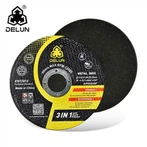
Core Manifestation: When workers operate angle grinders or cutters, resin cutting discs suddenly shatter or splinter during high-speed rotation. This not only results in damaged workpieces but is also the most common cause of serious workplace injuries.
Cause Analysis:
Lateral Force (Improper Grinding): Resin cutting discs are typically only 1–3 mm thick and designed to withstand radial (vertical) cutting forces. On construction sites, workers often use the side of the disc to grind welds or burrs for convenience, causing the mesh layer to tear instantly and trigger disc explosion.
Twisting or Jamming During Cutting (Disc Binding): When cutting thick steel or pipes, unstable hand movements or poorly secured workpieces can cause the disc to twist within the cut. This jams the spinning blade, generating excessive torque that leads to disc fracture.
Incompatible Speed or Overdue Use: Construction sites have various power tools. Installing a low-speed disc (e.g., 80 m/s) into a high-speed grinder creates centrifugal forces exceeding the bonding agent's tolerance. Additionally, using expired or moisture-damaged discs weakens the resin significantly, reducing strength.
Non-compliant Flange Installation: Using mismatched, worn, or over-tightened flanges causes uneven stress around the disc's center hole, leading to radial cracking under high-speed operation.