


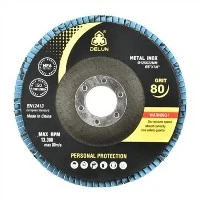
If you've ever spent time in a metal fabrication shop, auto body garage, or metalworking workshop, you've likely reached for an abrasive flap disc-those circular, multi-flap tools that look like a cross between a grinding wheel and a sanding belt. They're workhorses for everything from grinding weld beads to blending surfaces, but one question I get asked more than any other as a flap disc supplier is: "What's the wear rate of an abrasive flap disc?"
It's not a simple number to slap on a spec sheet, and that's part of why so many fabricators end up wasting money on the wrong discs, replacing them too often (or worse, too rarely) mid-job. Over 12 years in this industry, I've seen everything from new tradesmen burning through a disc in 10 minutes to veterans getting 8 hours of consistent work out of a single high-quality flap disc. The wear rate isn't just a factor of the disc itself-it's a mix of what you're grinding, how you're using the tool, and even environmental conditions. Let's break this down, and by the end, you'll have a realistic idea of what to expect, plus insights into how to get the most out of every disc you buy.
First, let's define what "wear rate" actually means in this context. For abrasive flap discs, wear rate is the amount of abrasive material lost from the disc's flaps per unit of material removed from your workpiece, or per hour of use. It's measured in things like grams of abrasive removed per minute, or square inches of metal ground before the disc is too dull to use. A lower wear rate means the disc lasts longer, doesn't require constant pressure to cut, and delivers consistent performance until the end of its life. A higher wear rate means you're spending more on replacements and stopping work more often to swap discs.
The biggest factor that impacts flap disc wear rate is the material you're working on. Not all metals are created equal, and the abrasive on the flap has to match the workpiece to keep wear low. Let's start with the most common material we supply flap discs for: stainless steel. Stainless is tough, it's corrosive-resistant, and it's full of chromium, which makes it harder than mild steel and more abrasive on your disc's flaps. If you're grinding stainless, you'll want a disc designed specifically for that task-our Flap Disc For Stainless Steel is engineered with zirconia alumina abrasive, which is sharper and more durable on high-chromium alloys. I've seen customers use our stainless flap discs for 2 to 4 hours of continuous grinding on 304 or 316 stainless, with a wear rate of about 0.5 to 1 gram of abrasive lost per minute. Compare that to a generic flap disc used on stainless, which can have a wear rate twice as high, burning out in under an hour because the abrasive wears away too fast instead of cutting through the metal.
If you're working on mild steel or carbon steel, the wear rate is a bit lower because these materials are softer and less abrasive. Our DELUN Flap Discs for Steel are designed for this exact application, using a blend of aluminum oxide and zirconia that balances cutting speed and longevity. For mild steel, you can expect a wear rate of around 0.3 to 0.7 grams per minute, with a single disc lasting 3 to 6 hours of use-longer if you're doing light blending or finishing, shorter if you're grinding heavy weld beads. I've had a customer in a structural steel fabrication shop tell me he gets 8 hours of continuous weld grinding out of one of our steel flap discs, and that's because he uses the right pressure (more on that later) and doesn't force the disc into the metal.
For softer metals like aluminum or brass, the wear rate is even lower, but here's a catch: soft metals can clog the flaps, which actually increases effective wear rate because the disc can't cut anymore and you have to replace it, even if the abrasive itself is still there. That's why we have specialized flap discs for non-ferrous metals, but if you're sticking to common metalwork, 90% of our customers are working with stainless and steel, so those are the numbers I'll focus on.
Next, the way you use the tool is a massive factor in wear rate. I've seen beginners hold the flap disc at a 90-degree angle to the workpiece, grinding straight into the metal like a angle grinder is a jackhammer. That's a surefire way to make a disc wear out 3 times faster. The correct angle for a flap disc is 15 to 30 degrees relative to the workpiece surface. When you hold it that way, only the tips of the flaps are doing the cutting, so the abrasive wears evenly, instead of the entire flap hitting the metal and causing excessive friction. Pressure matters too: a lot of people think harder pressure means faster grinding, but with flap discs, it's the opposite. You should only apply enough pressure to keep the disc cutting on its own-let the weight of the angle grinder do most of the work. Over-pressing causes the flaps to fold over instead of gliding, which wears the abrasive down in minutes and can even cause the disc to overheat, leading to glazing (when the abrasive grit gets rounded, so it can't cut anymore). Glazing is one of the biggest avoidable causes of high wear rate, and it's so easy to prevent just by adjusting your angle and pressure.
Disc quality is another huge variable. Not all flap discs are made the same, and there's a big difference between cheap, imported discs and premium ones designed for consistent performance. A cheap disc might have loosely packed flaps, abrasive grit that's not bonded well, or a flimsy backing that flexes too much. Those factors lead to uneven wear, where some flaps wear away while others are still sharp, making the whole disc useless early. Our DELUN Abrasive Flap Wheels for Metal are constructed with high-density, resin-bonded zirconia and aluminum oxide grit, with a rigid fiberglass backing that stays stable under load. We test every batch to make sure the flap wear rate stays consistent, so our customers don't get a disc that works great in the first 10 minutes and falls apart 10 minutes later. I've had a customer switch from a budget disc to ours and cut his disc replacement costs by 40% in the first month-he was shocked at how much longer the discs lasted.
Grit size also impacts wear rate, which is something a lot of people overlook. If you're doing heavy grinding of welds or removing large amounts of material, you want a lower grit size-think 36, 40, or 60. Coarser grit cuts faster, and each grit particle is larger and more durable, so wear rate is lower per unit of material removed. If you're doing finer work, like blending welds or preparing surfaces for painting, you'll use higher grits: 80, 120, or even 180. Higher grit has smaller abrasive particles, so wear rate is higher because you're removing finer layers of material, and each grit particle wears down faster. Our Flap Disc Grit For Sharpening for metal and stainless steel covers all these grit sizes, so you can pick the right one for your task and get the wear rate you need. For example, a 40-grit disc for heavy grinding will have a wear rate of ~0.4 to 0.8 grams per minute, while a 120-grit disc for finishing will be around 0.2 to 0.5 grams per minute- that makes sense, because the finer grit is working harder on a smaller scale.
Size matters too, and not just for how the disc fits your angle grinder. The most common size for metalworking is the 100mm (4-inch) disc, which is perfect for small, tight spaces, but it has a higher wear rate per hour than larger discs. Our Flap Disc For Metal Polishing 100mm is a popular option for auto body work and small fabrication jobs, but if you're doing large surface work like blending a whole steel beam, a 125mm or 180mm disc will have a lower wear rate because it covers more area per rotation, so the abrasive is used more efficiently.
So what's a realistic, average wear rate to plan for? For most metalworking applications, using a premium flap disc (like our DELUN line) at the correct angle and pressure, on mild steel or stainless steel, the average wear rate is between 0.2 and 1 gram of abrasive material lost per minute of use. That translates to a single disc lasting anywhere from 1 hour (for heavy, high-pressure grinding) to 10+ hours (for light blending or finishing). The key is tracking your own usage, because every shop has different tools, different tasks, and different operators. If you're currently going through a box of 50 discs a week and want to cut that number down, the first step is checking if you're using the right disc for your material, and if you're holding your angle grinder correctly.
A lot of new fabricators ask me if a lower price always means a higher wear rate. Not always, but more often than not, cheap discs are made with inferior materials to keep costs low, so their wear rate is higher. I always tell customers to look at cost per hour of use, not cost per disc. A $10 disc that lasts 8 hours is way better value than a $5 disc that lasts 2 hours-even though the per-disc price is double, the per-hour cost is half, and you're wasting less time swapping discs.


If you're looking to get the most out of your flap discs, here are a few quick tips I've picked up over the years: First, don't use a flap disc for something it's not designed for-flap discs are for grinding and blending, not for heavy stock removal that would be better suited for a grinding wheel. Second, keep your discs dry and stored flat. If you stack discs on top of each other, the flaps can get deformed, leading to uneven wear. Third, if a disc starts to glaze over (it stops cutting, you have to apply more pressure, and it leaves burn marks), you can gently clean it with a flap disc cleaning stick instead of throwing it away. That can extend the life by another 30 minutes or so.
At the end of the day, the wear rate of an abrasive flap disc isn't a fixed number-it's a relationship between the disc quality, your workpiece, your technique, and even how you store your tools. As a supplier, I don't just sell discs-I help our customers figure out which disc will give them the right wear rate for their specific jobs, because wasting money on overpriced, short-lived discs is a problem I see way too often in this industry. Whether you're working on stainless steel, mild steel, or need a disc for sharpening or polishing, we have options tailored to keep wear rates low and productivity high. If you're tired of replacing flap discs every hour, or want to optimize your current setup to cut costs, reach out-we can help you find the right solution for your workshop.
References
- Machining Data Handbook, 4th Edition. Society of Manufacturing Engineers, 2017.
- "Abrasive Flap Disc Performance and Wear Mechanisms". Journal of Manufacturing Processes, Vol. 45, 2021, pp. 789-798.
- Metal Fabrication Tooling and Equipment Report. National Tooling and Machining Association, 2022.
- "Best Practices for Abrasive Angle Grinder Use". Occupational Safety and Health Administration (OSHA), 2020.