When a high-quality resin cutting disc undergoes rigorous factory testing-including rotational speed and balancing checks-yet experiences breakage during actual operation by the end-user, it raises an immediate question: Is it a product quality defect, or are hidden variables at play on the shop floor?
Based on decades of abrasive manufacturing experience and field failure analysis, product certification is only half the story. The interaction between the tool, the machine, and the operator dictates real-world safety.
Here is a practical breakdown of why compliant resin cutting discs break in use, and how to differentiate between a manufacturing defect and an application mismatch.
1. The Core Culprits Behind "On-Site Breakage" (Beyond Factory Testing)
If laboratory batch testing confirms the disc's bursting speed meets international safety standards (such as MPA standards), the root cause usually shifts to dynamic variables during operation:
Excessive Side-Load Pressure (Cross-Cutting): Resin cutting discs (especially ultra-thin profiles like 1.0mm or 1.2mm) are engineered strictly for vertical, straight-line cutting. Any slight tilting of the angle grinder, shifting of the workpiece, or using the cutting edge for light grinding induces severe lateral stress, leading to immediate fracture.
RPM Mismatch (Over-Speeding): A standard mistake is mounting a disc onto a machine whose no-load speed exceeds the Maximum Operating Speed (80m/s) printed on the wheel label. Centrifugal force overstrains the resin bond before it even touches the metal.
Flange and Mounting Errors: Worn-out, warped, or mismatched flanges fail to clamp the disc evenly. If the paper blotter is missing or the nut is over-tightened, it creates micro-cracks around the center ring before the tool is even switched on.
Environmental Degradation (The Silent Variable): Resin-bonded wheels are sensitive to moisture and thermal fluctuations. If stored in damp warehouses or exposed to high humidity during maritime transit, the resin matrix hydrolyzes, significantly reducing its structural strength despite passing factory tests weeks prior.
2. How to Diagnose: Manufacturing Defect vs. Operational Failure
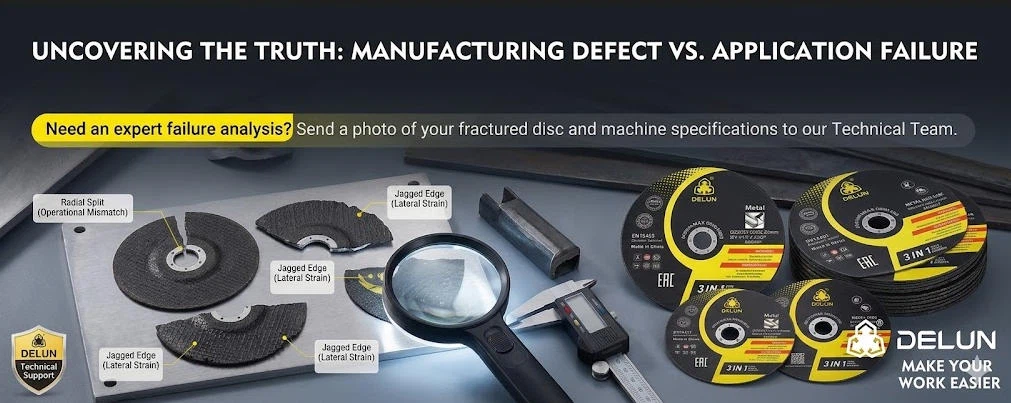
To determine accountability objectively, inspect the fractured fragments of the disc:
| Fractured Pattern | Likely Root Cause | Responsibility |
| Clean radial split from the center ring outwards | Over-speeding or severe impact upon initial contact. | Operational / Machine Check Needed |
| Rough, wavy, or jagged edges on the broken perimeter | Side-twisting, binding in the cut, or workpiece movement. | Operator Technique / Clamping |
| Delamination (glass fiber mesh completely separating) | Insufficient baking temperature or poor resin wetness during production. | Manufacturing Defect |
3. Our Quality Commitment & Preventive Protocols
As an industrial-grade abrasive manufacturer, we recognize that "passing factory standards" isn't enough; our products must survive real-world, high-intensity environments. To eliminate on-site risks, we implement a two-pronged safeguard:
Chemical and Mechanical Stability: Every batch undergoes destructive rotation tests at speeds significantly higher than the rated $80\text{ m/s}$ safety threshold, ensuring a wide safety margin.
Moisture-Proof Packaging: For long-distance export and unpredictable storage conditions, our premium lines utilize specialized sealed packaging to preserve the chemical integrity of the resin bond against humidity.
Need a technical assessment? If your team is experiencing inconsistent disc life or unexpected breakage, send us a photo of the fractured disc and your machine specifications. Our technical engineering team will run a comprehensive failure analysis to optimize your cutting parameter setup.