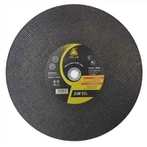
Cutting blades belong to the grinding wheel. The thin slices made of abrasive and binder resin used to cut ordinary steel, stainless steel and non-metallic materials are divided into resin cutting blades and diamond cutting blades.
After the cutting piece is installed on the flange, the cutting piece must maintain a static balance. Static balance is to combine the center of gravity of the cutting blade with its center of rotation. The specific static balance method is to place the flange on the mandrel and then place it on the guide rail of the gimbal. If unbalanced, the heavier part of the cutting blade will always turn to the lower part. Move the counterweight position of the ring tip of the flange end face to balance the center of the cutting blade. Repeat the above steps until the cutting blade can be fixed in any position on the rail. At this time, the cutting blade reaches a static balance. After installing a new cutting piece for primary static balance, install a grinder, trim the shape of the cut piece with a diamond pen, and then remove the cutting piece for secondary static balance before installation and use. The front and rear static balance can ensure better use of the cutting blade.
If the static balance is not performed, the cutting blade will vibrate during high-speed rotation. If the weight is light, the processing effect will be affected. In severe cases, the cutting blade will crack and the machine tool will be damaged. Therefore, static balance must be performed when installing the cutting blade.