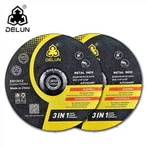
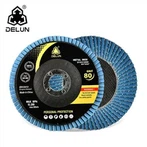
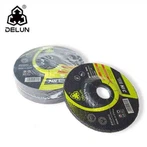
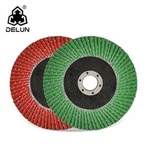
Cutting discs, essential tools for slicing materials like metal or concrete, face an inherent challenge: achieving both high sharpness and long durability concurrently is fundamentally impossible due to material science constraints. Sharpness enables efficient, clean cuts with minimal force, while durability ensures the disc withstands repeated use without premature failure. However, these properties conflict because sharpness relies on brittle, hard abrasives that fracture easily, whereas durability demands tougher, wear-resistant materials that resist deformation. This trade-off arises from the microscopic behavior of abrasive granules under stress. When a sharp edge engages with a workpiece, localized forces cause micro-cracks and fractures at the granule level-even soft materials can induce such damage over time, as demonstrated in studies where hair dulled stainless steel razor blades by propagating edge cracks rather than gradual wear. Consequently, optimizing one property inherently compromises the other.
Key Factors Exacerbating the Trade-off
Abrasive Granule Properties: Harder granules (e.g., ceramic alumina or zirconia) maintain initial sharpness but exhibit high brittleness, leading to rapid micro-fractures and granule pull-out during cutting. Softer granules self-sharpen slightly through controlled fracturing but wear down faster, reducing lifespan.5 Granule uniformity also plays a role; inhomogeneous microstructures accelerate crack propagation under load, as seen in blades where non-uniform edges dulled quicker despite the material's hardness advantage.3
Bonding System Limitations: The resin or vitrified bond holding abrasive granules must balance adhesion strength with flexibility. Strong bonds minimize granule loss for durability but can "glaze" over sharp edges, dulling the disc prematurely. Weaker bonds expose more granules for sharpness but increase disintegration risks under high-speed operations.
Disc Geometry and Thickness: Thinner discs (e.g., 2.5mm designs) enhance sharpness by reducing friction and enabling precise cuts, but their reduced mass makes them vulnerable to bending or shattering, especially during high-torque applications. Thicker discs offer better structural integrity for durability but sacrifice cutting efficiency.
Operational Stressors: External factors like excessive cutting speed or pressure amplify the conflict. For instance, high RPM generates heat that weakens bonds and accelerates granule fracture, while uneven feed forces cause localized wear hotspots. Even premium discs, such as Bosch's vacuum-brazed designs or Makita's stabilized variants, exhibit accelerated degradation when pushed beyond optimal parameters, as durability demands conservative use that limits peak sharpness.
Industry Attempts and Persistent Challenges
Manufacturers innovate through hybrid materials (e.g., combining ceramic and alumina grains) or advanced bonding technologies to mitigate the trade-off. Brands like Bosch emphasize "sharp and durable" profiles by enhancing granule cohesion or adding reinforcements like fiberglass mesh; however, these merely narrow-not eliminate-the gap, as field tests show such discs still require compromises based on material-hardness compatibility. Similarly, thinner, high-speed discs claim efficiency but rarely achieve longevity parity due to unavoidable edge vulnerability.4 Ultimately, material physics dictate that an ultra-sharp edge will always be fragile, while a durable design inevitably blunts faster under aggressive use. Users must prioritize based on application: sharp discs excel for precision tasks but demand frequent replacement, whereas durable discs suit high-volume work with reduced cutting speed. This inherent limitation underscores why no cutting disc can yet fulfill both ideals simultaneously without trade-offs.