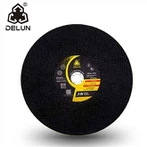
Grinding wheels are extremely tough, but damage can result when a wheel is dropped on a table or hard surface. Care should always be taken to prevent the wheel from becoming damaged, and if a wheel is compromised, it should not be used. By using a damaged wheel at 10,000 rpm, everyone in the room becomes susceptible to a potential accident waiting to happen.
It should also be noted that grinding wheels require more training than flap and fiber discs. A Type 27 grinding wheel requires a 30-degree angle while Types 28/29 require 0-to-15 degrees. Operators that use a Type 27 wheel too flat can increase the bevel, which generates heat and leads to wheel failure. Apply too much of an angle and the wheel will likely start spalling, which means it will break down prematurely. Grinding wheels can be hard to handle because they remove large cutting fragments from the workpiece, and the noise level is greater than its counterparts.
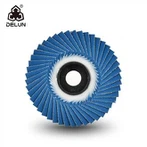
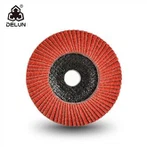
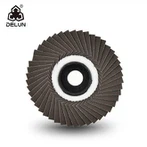
Flap discs also require proper care to maintain their integrity. The flaps that make up a flap disc are held down with strong adhesive, but that does not make the discs indestructible. If used improperly, such as at excessive angles, or jabbing the discs into tight places, or on an extremely sharp or rough workpiece, the flaps could potentially come apart during use. Further, without proper PPE, the operator or others in the area could get hurt. Flap discs require slightly more pressure than fiber discs to wear away the cloth backing to expose more sharp grain. Most operators leave plenty of life on used flap discs instead of applying enough pressure to wear away the cloth backing. Also, insufficient force will cause “capping”, preventing full use of the product. Capping is when metal adheres to the abrasive grain due to excessive heat and insufficient pressure. This can prevent the grain from fracturing which is needed so it can re-sharpen itself.
Fiber discs require less force to do the same amount of work as grinding wheels or flap discs. The required back-up pad provides a strong backing, similar to flap discs. However, the coating method on the paper allows for an aggressive cut similar to grinding wheels. Most operators prefer the higher cut-rate, lower tool vibration, noise reduction, and ease of use of fiber discs compared to grinding wheels. Fiber discs must be used correctly and with proper PPE. Back-up pads must be in good condition and must be made to be back-up pads. Using old fiber discs or cutoff wheels as back-up pads is dangerous and should not be attempted. Discs that have extreme curl should not be used because they can snag the workpiece, or become too brittle and break while under force. Fiber discs may not have the life of flap discs and grinding wheels, but the lower price point and versatility make them an operator favorite.