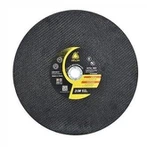
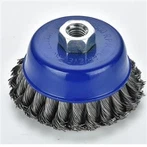
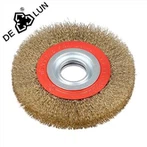
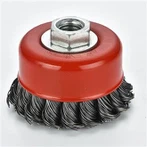
Today, DELUN will explain the main quality problems and their hazards in abrasive wheel:
1) Unqualified rotation strength

Rotational strength refers to the ability of the grinding wheel to resist rupture under the action of centrifugal force during the rotation of the grinding wheel. It reflects the tensile stress of the abrasive wheel. It is a very important indicator for the manufacture and use of the abrasive wheel. In order to ensure the safe use of the abrasive wheel, the standard lists unqualified rotation strength as a "fatal defect", that is, "defects that are dangerous or unsafe to the user or to the equipment". Years of quality inspections have found that the rotation strength of fiber-reinforced resin flake abrasive wheels and cymbal-shaped abrasive wheels is not ideal, some are lower than the maximum working speed, and some break before the specified rotation test speed; some reach the test speed but cannot It ruptures after 30s. The proportion of unqualified rotation strength is 7.1%-18.7%.
Fiber-reinforced resin flake abrasive wheels and cymbal-shaped abrasive wheels are mostly hand-held cutting and grinding, and the operator is close to the abrasive wheel. Therefore, once the rotation strength is poor, the abrasive wheel will break during the cutting or grinding process, which can easily cause personal injury and death.
2) Unqualified static balance
The abrasive wheel is an inhomogeneous object. When the abrasive wheel rotates, its mass center does not coincide with the rotation center and causes vibration. This state is called the unbalance of the abrasive wheel. Unbalanced grinding wheel will bring many harms:
Acting on the bearing of the grinding machine to cause the spindle to vibrate and accelerate the wear of the grinding machine's spindle;
It additionally increases the rotational stress that the abrasive wheel bears, reduces its rotational strength, and may even cause it to rupture during rotation;
Increase the vibration of the abrasive wheel and the workpiece system, which is manifested as vibration lines appear on the surface of the workpiece to be processed, and the processing accuracy and surface roughness are deteriorated;
Affect the uniformity of the abrasive wheel's self-sharpening, and make the abrasive wheel wear unevenly.
The static balance of the grinding wheel is also one of the main quality indicators reflecting the inherent characteristics and performance of the abrasive wheel. The unqualified static balance is listed as a "heavy defect" in the standard, that is, "severely reduce the performance of the product and have a serious impact on the performance of the processed part. Defects".
3) Unqualified hardness

Abrasive wheel hardness refers to the resistance of the bonding agent against the detachment of abrasive particles from the surface of the grinding wheel under the action of external force, or it is understood as the degree of difficulty for the abrasive particles to detach from the surface of the abrasive wheel. The hardness can more accurately reflect the grinding performance of the abrasive wheel, and it is one of the important indexes to measure the quality of the abrasive wheel. There are two requirements for the assessment of the hardness of the abrasive wheel:
The uniformity of hardness (the difference between the maximum value and the minimum value of the measured hardness values of each point) must meet the requirements of the standard;
The hardness compliance requirements, that is, the average value of the hardness (the arithmetic average of the hardness values measured at each measuring point) should be within the allowable range specified in the standard. The proportion of unqualified hardness is also quite high. For example, the unqualified hardness of flat abrasive wheels exceeds 20% of the total number of unqualified ones.
4) Unqualified aperture

The inner hole of the abrasive wheel is the installation benchmark, and the unqualified diameter of the abrasive wheel is listed as a "heavy defect" in the standard. The larger the hole diameter, the eccentricity of the abrasive wheel after installation will make the abrasive wheel unbalanced, and the vibration will be aggravated when rotating at high speed, which will affect the quality of grinding processing, and even cause the abrasive wheel to break and equipment damage. If the hole diameter is too small, the grinding wheel cannot be installed and cannot be used. If it is installed forcibly, the spindle will be scratched, and the abrasive wheel may also be concealed, which will cause the abrasive wheel to break when it is running, which may easily lead to accidents. As shown in Table 2, the unqualified pore size is the most serious in the spot check. It accounts for 16.7% of the total number of unqualified flat wheels, and 58.2% of the total number of unqualified cymbal wheels.
5) Wrong logo

The mark of the abrasive wheel indicates the basic performance of the abrasive wheel and plays an important role in guiding the user to use it. It cannot be ignored. Marking errors are listed as "major defects" in the standard. There are many problems in the logo, some of the logo content is incomplete; some of the logo content is wrong; even deliberately pretending to be shoddy, false or false, causing confusion for users, affecting use, damaging their interests, and may cause major accidents.
6) End face runout and radial runout are unqualified
End face runout and unqualified radial runout will cause the abrasive wheel to deviate and affect the balance performance, which will have a negative impact on the machine tool and the workpiece, so it should be controlled within the allowable range.