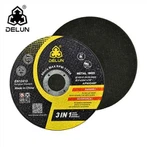
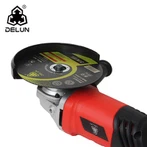
Flap discs (also known as leaf discs or multi-flap wheels) are grinding tools composed of multiple layers of abrasive cloth flaps stacked and bonded around a fiber or plastic core. They are widely used for rough grinding, medium grinding, and polishing of materials like metals (stainless steel, carbon steel), wood, and stone-for tasks such as removing weld scars, deburring, or pre-treating surface roughness. However, improper selection, operation, or maintenance often leads to issues like low grinding efficiency, poor surface quality, short service life, and even safety risks. Below is a detailed breakdown of common problem categories, cause analysis, and solutions, supplemented with preventive tips to enhance grinding performance and safety.
1. Low Grinding Efficiency (Slow Material Removal, Time-Consuming)
Problem Manifestations
Grinding the same material takes far longer than expected (e.g., removing a 5mm-thick weld scar requires repeated grinding for over 10 minutes).
The disc fails to quickly remove surface defects like burrs or rust, requiring excessive passes over the same area.
Core Causes
Incorrect Abrasive Grit Size: Using fine-grit flaps (e.g., 120#–180#) for rough grinding tasks (e.g., weld scar removal)-fine grits prioritize smoothness over material removal speed.
Mismatched Flap Material: Using wood-specific flap discs (with soft alumina abrasive) on hard metals (e.g., stainless steel), as the abrasive wears down too quickly to cut through tough surfaces.
Unfavorable Rotational Speed: Running the disc below the recommended speed (e.g., 3,000 rpm for a disc rated 4,500–6,000 rpm), reducing the abrasive's cutting force.
Insufficient or Excessive Pressure: Too little pressure means the abrasive barely contacts the material; too much pressure clogs the abrasive pores, preventing effective cutting.
Solutions
Select Grit Based on Task: Use coarse grits (36#–46#) for rough grinding (weld scars, thick rust); medium grits (60#–80#) for medium grinding (deburring, surface leveling); fine grits (100#–120#) for pre-polishing.
Match Flap Material to Workpiece: Choose zirconia alumina (ZA) flaps for hard metals (stainless steel, alloy steel); brown corundum (A) for mild steel/carbon steel; silicon carbide (C) for wood/stone.
Adjust Speed to Specifications: Check the flap disc's label for "recommended speed" (most metal-working flap discs require 4,000–6,000 rpm) and set the grinder accordingly.
Control Pressure: Apply moderate, consistent pressure-enough to make the flaps contact the material firmly but not so much that the disc slows down or the flaps fold over.
2. Poor Surface Quality (Scratches, Uneven Finish)
Problem Manifestations
Post-grinding surfaces have deep, irregular scratches (visible to the naked eye or felt by touch).
The surface is uneven, with high and low spots (e.g., grinding a steel plate leaves wavy marks).
Residues (abrasive particles, debris) stick to the workpiece, requiring extra cleaning.
Core Causes
Inconsistent Grit Size or Flap Wear: Mixed grits in the disc (e.g., some flaps 60# and others 120#) or unevenly worn flaps (some flaps are bald while others are new) cause uneven cutting.
Improper Pressure Application: Uneven hand pressure (e.g., pressing harder on one side of the disc) leads to uneven material removal.
Contaminated Flaps: Abrasive pores are clogged with metal chips (especially common when grinding soft metals like aluminum) or dust, making the disc "glaze over" and leave scratches.
Unsuitable Disc Hardness: Using a rigid flap disc (high-density flaps) on curved or uneven workpieces-rigid discs can't conform to the surface, leading to missed areas and uneven finishes.
Solutions
Choose High-Quality Discs: Opt for reputable brands with uniform grit distribution (avoid cheap discs with mixed grits). Replace the disc if flaps are unevenly worn (more than 50% of flaps are bald).
Practice Uniform Pressure: For handheld grinders, keep the disc parallel to the workpiece and move it in slow, steady strokes (avoid circular or erratic movements). Use a bench grinder for flat workpieces to ensure consistent pressure.
Prevent Clogging: For soft metals, use "anti-clog" flap discs (coated with lubricants to reduce chip adhesion) or pause occasionally to tap the disc gently and remove debris.
Match Disc Hardness to Workpiece Shape: Use flexible flap discs (low-density flaps) for curved surfaces (e.g., pipes, rounded metal parts); rigid discs for flat, large-area workpieces (e.g., steel plates).
3. Premature Wear (Short Service Life)
Problem Manifestations
The disc becomes unusable after only a few hours of light grinding (e.g., a flap disc for stainless steel wears out after grinding 2–3 small welds).
Flaps tear or fall off the core prematurely, leaving the disc unable to grind effectively.
Core Causes
Severe Material Mismatch: Using a disc designed for wood (soft abrasive) to grind high-hardness metals (e.g., tool steel)-the abrasive wears down instantly.
Over-Speeding: Running the disc above its "maximum allowable speed" (e.g., a 5,000 rpm disc used at 7,000 rpm) generates excessive heat, accelerating abrasive and bond degradation.
Excessive Pressure: Pressing too hard causes the flaps to fold, tear, or wear down faster (the bond holding the flaps to the core also weakens under high pressure).
Moisture or Corrosion: Storing flap discs in damp environments (e.g., near water tanks) causes the abrasive cloth to rust or the bond to soften, leading to flap detachment.
Solutions
Strict Material Matching: Never use wood/stone flap discs for metal, or vice versa. Check the disc's label (e.g., "for stainless steel only") before use.
Avoid Over-Speeding: Always confirm the grinder's speed matches the disc's maximum allowable speed (marked on the disc's core or packaging).
Reduce Unnecessary Pressure: Let the disc's abrasive do the work-moderate pressure extends life by 30–50% compared to heavy pressure.
Store Properly: Keep flap discs in a dry, ventilated, and cool area (away from moisture, direct sunlight, and heat sources). Use airtight containers for long-term storage.
4. Safety Risks (Flap Detachment, Vibration)
Problem Manifestations
Flaps suddenly tear off during grinding, flying outward (a major injury risk).
The grinder vibrates violently, making it hard to control and increasing operator fatigue.
Core Causes
Low-Quality Bonding: Cheap discs use weak adhesives to bond flaps to the core-high-speed rotation or pressure causes flaps to separate.
Damaged Core or Flaps: Using a disc with pre-existing cracks (in the core) or torn flaps (from improper storage) amplifies vibration and flap detachment risk.
Incorrect Installation: The disc's center hole doesn't match the grinder's spindle (e.g., a 16mm hole disc on a 20mm spindle), causing the disc to wobble and vibrate.
Solutions
Prioritize Safety-Certified Discs: Choose discs with CE or ANSI certifications (ensuring bond strength and structural safety). Avoid unbranded discs with no certification marks.
Inspect Before Use: Check for cracks in the core, torn/missing flaps, or loose bonding. Discard any damaged discs immediately.
Install Correctly: Ensure the disc's center hole aligns with the grinder's spindle. Use the correct flange (washer) to secure the disc-over-tightening or under-tightening both cause vibration.