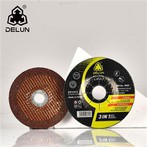
Let’s start with grinding wheels, the roughest and toughest of the three. They are created by combining resins, fillers, and grain together into a mix and forming the wheel using pressure, time and heat. Once cured, the wheels are extremely hard and can handle the most aggressive grinding applications.
Flap discs are made out of cloth backing and abrasive material. Most of the material used for flap discs can be also used for belts, quick-change discs, and other shaped products. The material is slit and cut into small pieces called flaps. These flaps are held in place by adhesive, pressed onto the backing plate, then cured to set the adhesive forming their shape. Flap discs primarily have two types of backing plates, fiberglass or plastic. Fiberglass is more rigid and less flexible than plastic. If the job is more demanding, fiberglass will be able to remove more material faster. Most plastic backing plates are trimmable to help increase the life and offer additional conformability. Both backing types for flap discs are available in Type 27 wheels which are used at angles from 0-to-15 degrees, and fiberglass backing is used in Type 29 wheels from 15-to-25 degrees. |
Fiber discs are also made with abrasives, but the backing is vulcanized reinforced paper. They are strong enough to handle a resin-over-resin coating system, and they are also able to withstand heat generated during grinding.
Grinding wheels and flap discs do not require a back-up pad like their cousin, the fiber disc. Fiber discs require a back-up pad because their reinforced fiber backing alone is not strong enough to withstand the forces of grinding. All three products are available with a 5/8”-to-11″ backing plate or hub insert. The benefits of the 5/8”-to-11″ are easy on-and-off operation without the need for tools, which reduces the change out time. |