



What is the cutting resistance of thin cutting discs?
In the world of cutting tools, thin cutting discs play a crucial role in various industrial and DIY applications. As a supplier of thin cutting discs, I often encounter questions from customers about the concept of cutting resistance. Understanding cutting resistance is essential for both manufacturers and users as it directly impacts the performance, efficiency, and lifespan of the cutting discs.
Cutting resistance can be defined as the force that opposes the cutting action of a thin cutting disc. When a cutting disc comes into contact with the workpiece, it has to overcome several types of resistances to make a successful cut. These resistances can be broadly categorized into mechanical, thermal, and frictional resistances.
Mechanical resistance is mainly related to the physical properties of the workpiece material. Different materials have different hardness, toughness, and density, which directly affect the cutting force required. For example, cutting through a high-strength steel will generate a higher mechanical resistance compared to cutting a softer aluminum alloy. The structure of the material also matters. A material with a fibrous or laminated structure may offer more mechanical resistance as the cutting disc needs to break the fibers or layers during the cutting process.
Thermal resistance is another significant factor. During the cutting process, a large amount of heat is generated due to the friction between the cutting disc and the workpiece. The cutting disc has to withstand this heat without losing its structural integrity or cutting performance. High-quality thin cutting discs are designed to dissipate heat effectively. If the cutting disc cannot handle the thermal stress, it may warp, crack, or lose its abrasive particles, leading to a decrease in cutting efficiency and an increase in cutting resistance.
Frictional resistance occurs at the interface between the cutting disc and the workpiece. The surface roughness of both the cutting disc and the workpiece, as well as the type of lubrication (if any) used, can influence the frictional force. A smooth-surfaced cutting disc may reduce frictional resistance to some extent, but it also depends on the material being cut. For example, when cutting a sticky or gummy material, the frictional resistance can be quite high, and the cutting disc may tend to clog, further increasing the resistance.
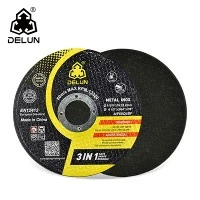
As a supplier, we focus on optimizing our thin cutting discs to minimize cutting resistance. We use advanced manufacturing techniques and high - quality abrasive materials. For instance, our 115mm 4.5inch DELUN Cutting Disc Abrasive Cutting Discs are made with a special blend of abrasives that are designed to cut through various metals with low resistance. The abrasive grains are carefully selected to have the right hardness and sharpness, allowing them to penetrate the workpiece easily and break the material with less force.
Our 180mm Metal Cutting Disc is another product that showcases our efforts in reducing cutting resistance. With a larger diameter, it can cover more area and cut more efficiently. The disc is engineered to have a well-balanced structure, which helps in distributing the cutting force evenly across the disc surface. This not only reduces the overall cutting resistance but also improves the stability of the cutting process, resulting in a smoother and more accurate cut.
The 4.5" Metal Cut Off Wheels are popular among users due to their versatility and low-resistance cutting performance. These wheels are designed to fit most standard angle grinders, providing a convenient solution for metal cutting tasks. The thin design of the wheels reduces the amount of material that needs to be removed during the cutting process, thus lowering the cutting resistance.
Our Thin Metal Cutting Disc is specifically tailored for applications where precision and low-resistance cutting are required. The thin profile of the disc allows for minimal material wastage and reduces the contact area between the disc and the workpiece, which in turn decreases the frictional and mechanical resistance.
The Metal Cutting Wheel for Angle Grinder is engineered to work seamlessly with angle grinders, one of the most commonly used tools in metalworking. By using high-quality binders and abrasives, we ensure that the wheel maintains its cutting edge and reduces the cutting resistance throughout its lifespan.
In addition to the design and material selection, proper usage and maintenance also play a crucial role in reducing cutting resistance. When using thin cutting discs, it is important to select the right speed and feed rate according to the material being cut. Using a speed that is too high can generate excessive heat and increase the cutting resistance, while a speed that is too low may not allow the disc to cut efficiently. Regular inspection and cleaning of the cutting disc can also prevent clogging and maintain its cutting performance.


By understanding the concept of cutting resistance and taking appropriate measures to reduce it, users can achieve better cutting results, increase the lifespan of the cutting discs, and ultimately save time and cost. Our company is committed to providing high-quality thin cutting discs that are optimized for low-resistance cutting. Whether you are a professional in the metalworking industry or a DIY enthusiast, our products can meet your cutting needs.
If you are interested in learning more about our thin cutting discs or would like to discuss your specific requirements, feel free to contact us. We are always ready to assist you in finding the best cutting solution for your projects.
References
- "Cutting Tool Technology" by John A. Schey.
- "Manufacturing Processes for Engineering Materials" by Serope Kalpakjian and Steven R. Schmid.